In the context of today’s era, the rapid development of industry, agriculture and other professions is accompanied by consequences affecting the living environment. In particular, the livestock industry is facing increasingly greater challenges due to the increase in the world’s population, accompanied by an increase in food demand, requiring the livestock industry to endure increasing pressure to provide safe and sustainable food for humans. Behind the impressive numbers in production, the issue of ensuring the environment becomes a huge challenge with the increase in the scale of livestock farming.
Food quality depends not only on the way animals are cared for but also on the management of the environment around them. Therefore, it is necessary to have a truly effective solution to be able to manage waste in the best way, not only to handle odor and environmental problems, but also to bring economic efficiency from the huge amount of waste that the livestock industry creates.
The oldest and most widely used solution is to use microorganisms for treatment. Let’s take a closer look at this solution to be able to choose the most suitable one for your livestock model. Microorganisms used in odor treatment are usually bacteria and fungi that can decompose organic substances that cause unpleasant odors. The popular microorganisms today include: Bacillus; Pseudomonas; Streptomyces; Trichoderma, etc. So what do these microorganisms have in common?

Hình ảnh Vi sinh (Nguồn: Internet)
Advantages of microorganisms
One of the advantages of microorganisms is the ability to reduce odors from animal waste, thanks to the mechanism of eating waste and converting waste into odorless substances. With a natural digestion mechanism, it is considered a fairly safe solution to choose. Each strain of microorganisms will be suitable for different types of waste (need to learn and use correctly for the purpose of each type of microorganism), for example: Bacillus strain is often used to decompose organic matter in manure and other organic waste; Trichoderma strain is a type of fungus, often used in the process of decomposing organic matter in soil and organic fertilizers. The advantages of microorganisms in treating livestock waste odors can be summarized as follows:
- Control odors through natural mechanisms
- Quite safe to use
In addition to the advantages, using microorganisms also has inherent limitations, which is also a problem for users, specifically
To achieve the above effects and advantages, the use of microorganisms will require a fairly expensive cost, because microorganisms need to be cultured before being used in a new environment, need to be supplemented continuously and at high density to compensate for the amount of dead microorganisms (considered foreign microorganisms, easily shocked by the living environment), especially in large-scale livestock environments with huge waste loads. The time for microorganisms to process waste is also very slow.
As can be said above, environmental conditions directly affect their ability to function (this is true for all strains of microorganisms). Over-reliance on microorganisms can lead to resistance (their ability to adapt, previous control measures may no longer be effective, posing a challenge to maintaining the balance of microorganisms in the livestock environment), making them no longer as effective as before. For example, you can imagine, when we change our living environment from a cold country to a hot country, it is very difficult to adapt immediately like the natives.
More broadly, the use of microorganisms to treat the environment can also affect the natural biosphere, especially the elimination of some microorganisms, which can cause ecological imbalance. Summarizing the advantages and disadvantages of microorganisms in treating livestock environments, it is emphasized that this process needs to be carried out carefully to ensure a balance between economic efficiency and environmental protection.
So is there another solution to overcome the disadvantages of using microorganisms?
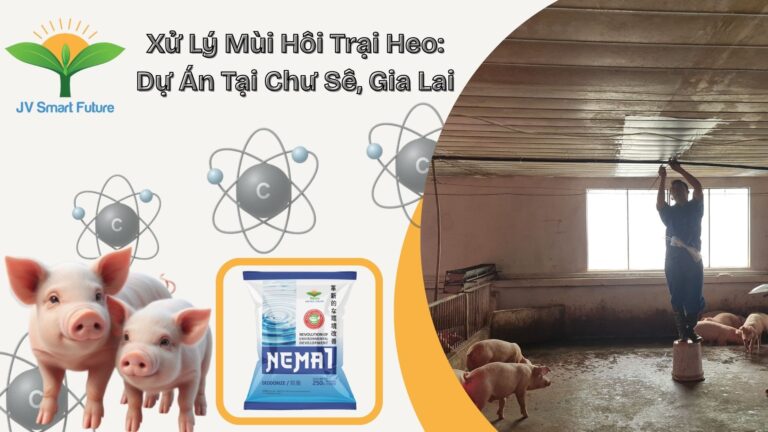
Japanese scientists recently introduced a new material, Organic Carbon, researched and developed by JVSF Company in Vietnam, applied in waste treatment, odor treatment, and environmental improvement with the trade name Nema1.
What is Organic Carbon?
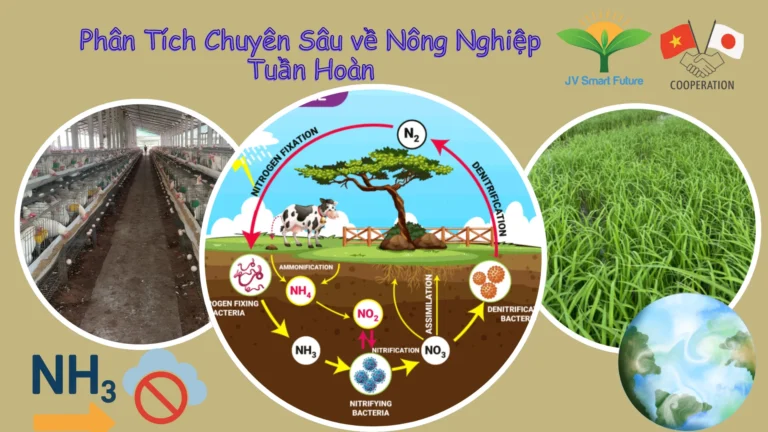
As a physical active ingredient, Organic Carbon easily breaks down organic molecular chains in waste, quickly decomposes organic waste, not only making waste odorless but also helping to balance the environment for internal microorganisms, helping them to develop easily, thereby adding to the treatment efficiency, helping the subsequent waste treatment steps to be carried out conveniently. According to reports, the solution applying Organic Carbin technology treats up to 80% of total gases, and more than 90% of toxic Ammonium gas (NH3) inside the livestock barn environment.

Odor treatment efficiency of Organic Carbon inside barns (source: JVSF)
Organic Carbon is extracted from a mixture of organic plant materials, environmentally friendly, safe for users and pets.
References: Link to introduce Odor treatment solution with Nema1:https://jvsf.vn/product/nema1/
CÔNG TY CỔ PHẦN TƯƠNG LAI THÔNG MINH NHẬT VIỆT
JAPAN VIETNAM SMART FUTURE JOINT STOCK COMPANY (JVSF)
Website: www.jvsf.vn – Email: info@jvsf.vn
Trụ sở chính: Ấp 4, xã Mỹ Thạnh Đông, huyện Đức Huệ, tỉnh Long An, Việt Nam Điện thoại : 027 23 89 88 38
Chi nhánh TP. Hồ Chí Minh: SH06-SH07, Tòa nhà Opal, Saigon Pearl, số 92 Nguyễn Hữu Cảnh, phường 22, quận Bình Thạnh, TP Hồ Chí Minh – Hotline: 0945 30 60 68
Chi nhánh Hà Nội: Số 33 ngõ 71 phố Đỗ Quang, phường Trung Hòa, quận Cầu Giấy, Hà Nội – Hotline: 0946 17 37 68