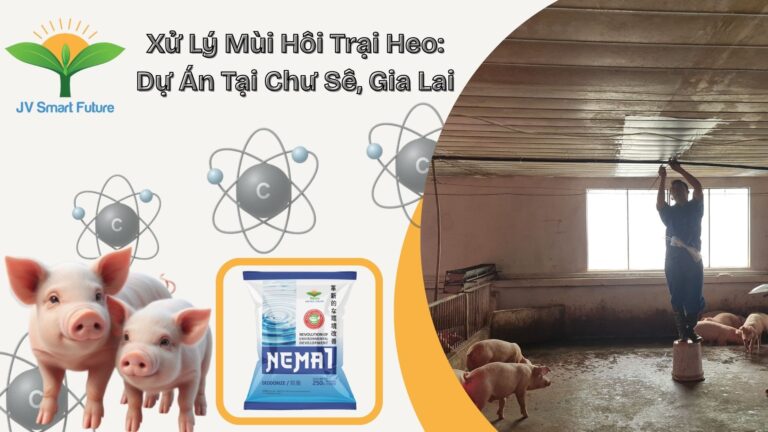
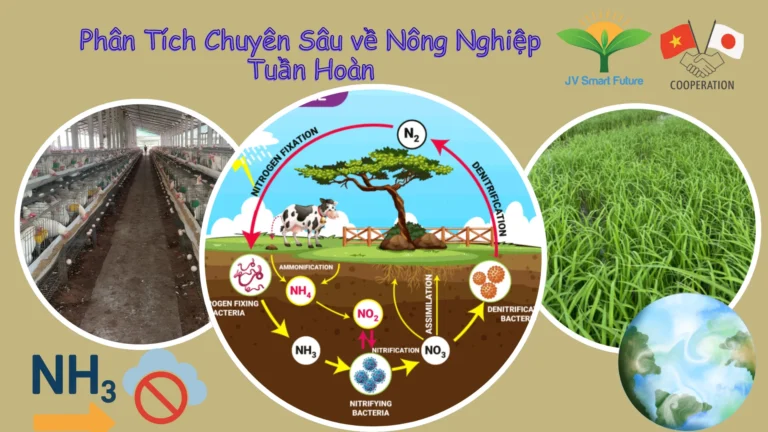
New animal waste inside the barn is the main source of odor (source: JVSF)
Odors from other areas on the farm such as:
- Wastewater ditches, sumps, wastewater treatment systems. There is odor in these areas but the load will be less than inside the barn, because when there is water, anaerobic microbial activities often occur, mainly creating CH4 (odorless). The odor in this area is only created from the surface of the wastewater, so it is insignificant or the load is not enough to affect distant areas.

Odors from other areas are only created from the surface (source: JVSF)
Therefore, odor treatment solutions need to focus on new waste discharged daily on the barn floor.
CURRENT FARM ODOR TREATMENT SOLUTIONS
Using microorganisms Bio
As a traditional solution, with the advantage of a natural treatment process with the waste digestion mechanism of specific microorganisms, using microbial preparations is a popular solution today. However, the disadvantage of the method is that before use, it is necessary to culture and adjust the density of microorganisms corresponding to the waste load; selecting the type of microorganisms suitable for the waste… are limitations, so the actual application in Vietnam is still inadequate and has not been thoroughly treated, or if you want to be effective, the cost is very high.

Using microorganisms to treat farm odors (illustrative image)
Using a mesh cover behind the exhaust fan, spraying essential oils (mainly water mixed with essential oils)
Covering a mesh cover behind the exhaust fan is one of the methods that farms are interested in and researching to invest in. However, the source of the farm odor comes from the waste and new wastewater on the barn floor. Solving it from behind the exhaust fan is considered a “top-down” method, not thorough, deceiving the sense of smell in locations near the barn. When far from the barn, such as in concentrated residential areas, the essential oil smell is gone and the smell is still not treated. This solution is also wasteful with high initial investment costs. In addition, the rear screen reduces the velocity of fresh air flow inside the barn, affecting the breathing of livestock.

Cover the mesh behind the exhaust fan (illustrative image)
Other odor treatment methods
In developed countries such as Europe and North America, the gas neutralization method is quite commonly applied. To apply this method, it is necessary to design and invest in a gas recovery system from the beginning. The gas inside the barn is brought to a centralized treatment area, where the gas passes through the filter plates: Acid filter (treats NH3) – Base filter (treats H2S) – Microbiological filter (treats remaining volatile fatty acids).

Gas neutralization method (illustrative image)
In Asian countries (popular in China, Thailand), the method of using highly oxidizing chemicals to decompose odor-causing molecules is commonly used. However, applying these methods in Vietnam is considered unfeasible because the initial investment cost is very high, the existing system model of farms regarding exhaust fans and operations needs to be upgraded, in addition, the chemicals used are toxic to livestock and humans…

… is done conveniently. According to reports, this solution treats up to more than 80% of all gases, and more than 90% of Ammonia gas.

… href=”https://youtu.be/j-c0m1SRtq0″>https://youtu.be/j-c0m1SRtq0

CÔNG TY CỔ PHẦN TƯƠNG LAI THÔNG MINH NHẬT VIỆT
JAPAN VIETNAM SMART FUTURE JOINT STOCK COMPANY (JVSF)
Website: www.jvsf.vn – Email: info@jvsf.vn
Trụ sở chính: Ấp 4, xã Mỹ Thạnh Đông, huyện Đức Huệ, tỉnh Long An, Việt Nam Điện thoại : 027 23 89 88 38
Chi nhánh TP. Hồ Chí Minh: SH06-SH07, Tòa nhà Opal, Saigon Pearl, số 92 Nguyễn Hữu Cảnh, phường 22, quận Bình Thạnh, TP Hồ Chí Minh – Hotline: 0945 30 60 68
Chi nhánh Hà Nội: Số 33 ngõ 71 phố Đỗ Quang, phường Trung Hòa, quận Cầu Giấy, Hà Nội – Hotline: 0946 17 37 68