Table of Contents
- Part I: Choosing the Right Muscovy Duck Breed
- Part II: Detailed Muscovy Duck Rearing Process
- Part III: Health Management and Disease Prevention
- Part IV: Harvesting and Economic Efficiency
- Conclusion and Recommendations
Part I: Choosing the Right Muscovy Duck Breed
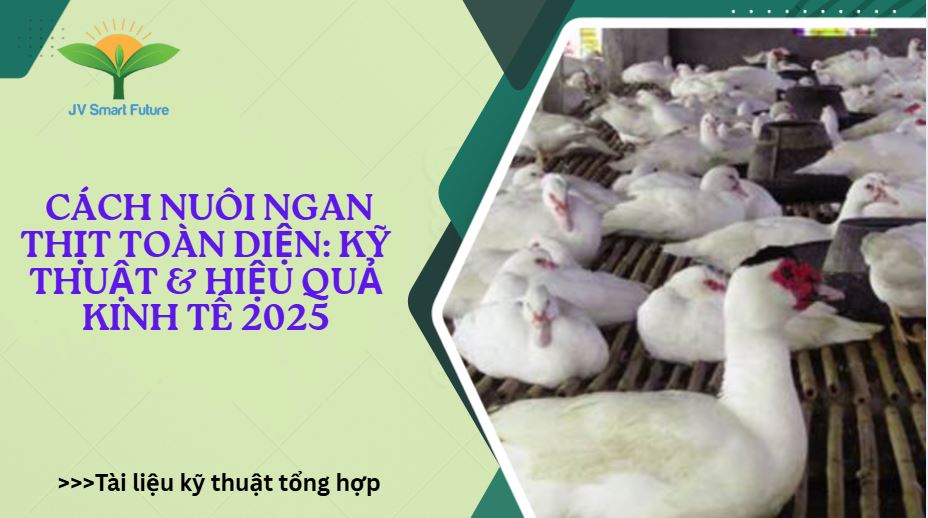
Selecting the right breed is the foundation, determining 50% of the success of the farming process. Each Muscovy duck breed has its own advantages and disadvantages, suitable for different conditions and farming goals. This is the first and most critical step in learning how to raise Muscovy ducks successfully.
1.1. Local Muscovy Duck (Common Muscovy)
The Local Muscovy is a native breed that has been domesticated in Vietnam for a long time. This breed is small in stature, with adult drakes weighing around 3.0 – 4.0 kg and hens from 2.0 – 2.5 kg.
- Advantages: Well-adapted to harsh climate conditions and minimal care. They have high natural resistance and are less prone to diseases. Notably, the meat quality is very flavorful and firm, highly favored by the market. Their good foraging ability helps reduce feed costs.
- Disadvantages: Slow growth rate, requiring a longer rearing period (usually over 3 months). Lower meat yield compared to hybrid and imported breeds.
1.2. High-Yield French Muscovy (R31, R51, R71)
French Muscovy ducks are high-yield meat-type lines imported from France, with the R-series from Grimaud Frères being the most prominent. They have become the backbone of the industrial Muscovy duck farming sector in Vietnam.
- Advantages: Extremely fast growth rate, can be ready for market in just 70-80 days. Large body weight (drakes 5.0 – 6.0 kg, hens 2.8 – 3.5 kg). High carcass and breast meat yield, with a very low Feed Conversion Ratio (FCR) of about 2.6 – 2.8.
- Disadvantages: Require strict farming, nutrition, and sanitation conditions. They have lower disease resistance than local Muscovies and are sensitive to weather changes. The initial cost of ducklings is high.
1.3. Hybrid Muscovy
Hybrid Muscovies are the offspring of a French drake and a local hen, a practical solution that combines the advantages of both parent breeds.
- Advantages: Faster growth rate than the Local Muscovy, but with better disease resistance and adaptability than the French Muscovy. Suitable for semi-industrial or free-range farming models.
- Disadvantages: Lack of uniformity within the flock due to the genetic diversity of the local hens. Productivity cannot match that of purebred French Muscovies.
1.4. Comparison Table of Muscovy Duck Breeds
To aid in decision-making, the table below summarizes the key metrics of the three main breed groups.
| Metric | Local Muscovy | Hybrid Muscovy | French Muscovy (R71) |
|---|---|---|---|
| Rearing Period | > 90 days | 85 – 95 days | 70 – 80 days |
| Avg. Weight (Drake/Hen) | 3.5 kg / 2.2 kg | 4.2 kg / 2.8 kg | 5.5 kg / 3.2 kg |
| Feed Conversion Ratio (FCR) | 3.2 – 3.5 | 2.9 – 3.1 | 2.6 – 2.8 |
| Technical Requirements | Low | Medium | High |
| Meat Quality | Excellent, firm | Good | Good, lean |
| Suitable Model | Free-range, smallholder | Semi-industrial | Industrial, large-scale farm |
Part II: Detailed Muscovy Duck Rearing Process
The process of raising meat Muscovy ducks is a series of closely linked technical stages. Mastering the methods of raising Muscovy ducks and strictly adhering to the requirements at each stage is crucial for the success of the entire flock.
2.1. Housing Preparation
- Location: The house should be built in a high, dry area that is cool in summer and warm in winter, away from residential areas.
- Flooring: Cement or brick floor with a slight slope for easy drainage. Always maintain a 5-10 cm thick layer of litter (rice husks, sawdust), which must be kept dry and clean.
- Yard and Pond: Muscovies are waterfowl. Providing a spacious yard and a clean pond or pool for them to swim in helps keep them healthy and cool.
- Sanitation: Before introducing a new flock, the house must be left empty, scrubbed, and disinfected with lime powder or a specialized chemical disinfectant.
2.2. Selecting Ducklings
The quality of the initial stock determines 50% of the flock’s success. Ducklings should be sourced from reputable hatcheries with clear origins.
- Selection Criteria: Active, bright eyes, fluffy and dry down. A neat abdomen with a dry, closed navel. Shiny legs, stands steadily, and free of deformities.
- Rejection Criteria: Dry shanks, crooked beak, open navel, heavy abdomen, matted down, chirping constantly or weakly.
2.3. Brooding Techniques for Ducklings (1 – 21 days old)
This is the most sensitive and decisive phase for the survival rate and uniformity of the flock later on. This is a core step in how to raise Muscovy ducklings.
- Temperature: The most critical factor. Use heat lamps to ensure the right temperature and observe the ducklings’ behavior to make adjustments.
- Week 1: 30 – 32°C (86 – 90°F)
- Week 2: 28 – 30°C (82 – 86°F)
- Week 3: 25 – 28°C (77 – 82°F)
- Lighting: Provide continuous light (24/7) for the first 2-3 weeks to encourage eating, drinking, and acclimatization.
- Nutrition and Water:
- Water: Provide clean water 24/7. For the first 3 days, add Electrolytes and Vitamin C to combat stress and boost immunity.
- Feed: Use commercial starter feed for ducklings (20-22% protein). Feed multiple times a day (5-6 times), scattering it thinly on flat trays.
- Density: About 15 – 20 birds/m² within the brooding area.
2.4. Grow-Out Phase (From 22 days old)
After the brooding phase, the goal shifts to maximizing growth rate and feed efficiency.
- Environment: Reduce stocking density to 4 – 5 birds/m². Maintain dry litter and a well-ventilated house.
- Nutrition: Gradually switch to a commercial grower feed (17-19% protein). You can supplement with green vegetables, corn, and paddy rice to reduce costs and improve meat quality.
- Care: Monitor the flock’s health daily, quickly identifying and isolating any birds showing abnormal signs. Ensure an adequate supply of clean water for both drinking and bathing.
Part III: Health Management and Disease Prevention
The cost of prevention is always much lower than the cost of treatment. A comprehensive health program is key to minimizing risks.
3.1. Biosecurity Principles
Biosecurity is a system of measures designed to prevent pathogens from entering and spreading on the farm.
- Practice “All-In, All-Out”: Raise and sell the entire flock at the same time, then leave the house empty for thorough cleaning to break the disease cycle.
- Control Access: Minimize the entry of people and vehicles into the farming area. Always have disinfectant footbaths and require protective clothing.
- Regular Cleaning and Disinfection: Spray disinfectant in the housing and surrounding areas periodically, 1-2 times per week.
- Control Intermediate Hosts: Implement effective control programs for rodents and wild birds.
- Use Probiotics: For sustainable environmental management, odor reduction, and pathogen inhibition, farmers can consider using probiotic products. A notable product is Organic Carbon, which helps decompose organic waste, improves litter quality, and creates a healthier living environment for the ducks.
3.2. Vaccination Schedule for Muscovy Ducks
Vaccination is an indispensable tool for creating active immunity. The schedule may vary depending on local disease pressure and should be discussed with a veterinarian.
| Age (Days) | Vaccine | Administration |
|---|---|---|
| 3 – 5 | Duck Virus Hepatitis Type I Vaccine | Eye/Nose drops |
| 7 – 10 | Duck Plague Vaccine (1st dose) | Subcutaneous injection (neck) |
| 14 | Fowl Cholera Vaccine (1st dose) | Subcutaneous injection (neck) |
| 21 – 25 | Duck Plague Vaccine (2nd dose – booster) | Subcutaneous injection (neck) |
| 35 – 40 | Fowl Cholera Vaccine (2nd dose – booster) | Subcutaneous injection (neck) |
| 45 | Avian Influenza Vaccine (if at risk) | Intramuscular injection |
3.3. Common Diseases in Muscovy Ducks
- Duck Plague (Duck Virus Enteritis): Caused by a virus, with very high mortality. Symptoms: sudden death, greenish-white diarrhea, swollen head. Vaccination is the only prevention.
- Duck Virus Hepatitis: Causes mass mortality in ducklings under 3 weeks old. Symptoms: convulsions, death in an arched-back position. Prevented by vaccination.
- Fowl Cholera (Pasteurellosis): A bacterial disease. Symptoms: high fever, loss of appetite, diarrhea. Prevented by vaccination and good sanitation.
- Paratyphoid (Salmonellosis): Primarily affects ducklings. Symptoms: diarrhea with air bubbles, pasted vent. Prevented by sourcing disease-free stock.
Part IV: Harvesting and Economic Efficiency
The final stage is converting the product into financial results. Determining the right harvest time and analyzing costs are key.
4.1. Optimal Harvest Time
Harvesting too early reduces yield, while harvesting too late increases feed costs inefficiently.
- Time Indicators: French Muscovy (70-80 days), Hybrid Muscovy (85-95 days), Local Muscovy (> 90 days).
- Physical Indicators: The most reliable sign is when the ducks are fully feathered, with feathers fitting tightly against the body. When you stroke the feathers against the grain, they should feel stiff, with no soft downy feathers (pinfeathers) left.
- Before Sale: You can “finish” them with corn and paddy for about 10 days before selling. Stop all antibiotic use according to withdrawal period recommendations (usually 7-14 days).
4.2. Cost and Profit Analysis
To assess feasibility, creating a detailed economic model is necessary.
- Main Costs: Duckling cost, feed cost (accounts for 60-70% of total costs), veterinary costs, electricity, water, labor.
- Revenue: Depends on the total live weight produced and the selling price per kg.
| Category | Local Muscovy | Hybrid Muscovy | French Muscovy (R71) |
|---|---|---|---|
| Production Cost / kg of live weight | High | Medium | Low |
| Expected Sale Price (/kg) | Very high (specialty price) | Good | Standard |
| Profit Potential | High if there is a niche market | Stable | Very high with good management |
Note: These figures should be calculated by the farmer based on the actual conditions of their farm and market prices at the time.
Conclusion and Recommendations
Raising Muscovy ducks for meat is a sector with high economic potential; however, success depends on building a suitable strategy.
- For small-scale, household farms: Prioritize Local Muscovy or Hybrid Muscovy to take advantage of their good disease resistance and lower investment costs. A successful strategy is to focus on the unique meat quality to sell to a premium market segment.
- For large-scale, industrial farms: Choose high-yield French Muscovy lines to maximize productivity, shorten capital turnover time, and supply a uniform product to the market.
Regardless of the chosen model, success depends on understanding and accurately implementing technical procedures, especially during the brooding stage and disease prevention through vaccination and biosecurity.
Additional References
Detailed Technical Guide
To learn more about the technical aspects of raising R71 French Muscovy, one of the most popular high-yield breeds, you can consult the detailed document here:
- #BroodingDucklings, #DuckDiseasePrevention, #DuckFarmingTechniques, #DuckFeed, #FarmEnvironmentManagement, #FarmingStartup, #FrenchMuscovy, #HowToRaiseMuscovyDucks, #HybridMuscovy, #Livestock, #LocalMuscovy, #MuscovyDuck, #MuscovyDuckFarming, #Probiotics, #ProfitableDuckFarming, #WealthFromAgriculture, Agriculture, OrganicCarbon