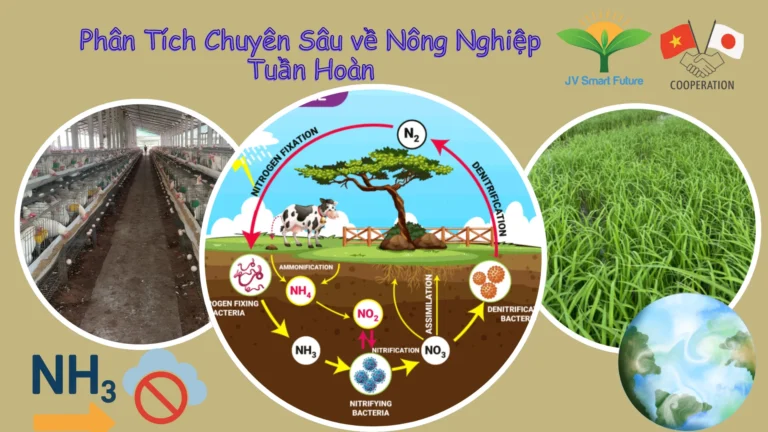
Degraded Soil: Causes and 3 Comprehensive Restoration Solutions
I. Introduction: Reviving the “Lifeblood” from Degraded Soil
After decades of intensive farming and reliance on chemical fertilizers, land in many areas is facing severe degradation. The result is degraded soil that is compacted, acidic, has an imbalanced microbial ecosystem, and has lost its natural fertility. The soil, which is the “cradle” for nurturing crops, is gradually being depleted, leading to reduced yields, increased production costs, and unstable agricultural product quality.
Faced with this reality, restoring degraded soil is no longer just an agricultural technique but has become an urgent requirement to restore the vitality of the land and move towards sustainable agriculture.
Improving and restoring the quality of degraded soil offers a dual benefit:
- For crops: It creates an ideal environment for root systems to develop in degraded soil, optimizing nutrient absorption, helping plants grow healthily, and enhancing their natural resistance.
- For the environment: It contributes to protecting water resources, reducing greenhouse gas emissions, and preserving soil biodiversity.
Especially in organic farming, where chemical fertilizers and pesticides are not used, proactively restoring and continuously improving soil health is considered the core philosophy and the foundation for all success.
II. The 3 Golden “Pillars” for Effective Degraded Soil Restoration
To restore and build fertile land from degraded soil, farmers need to focus on 3 main pillars, likened to a “three-legged stool” essential for soil health. Addressing all three aspects simultaneously will create a solid foundation for successful and sustainable organic farming.
- Increasing nutrient content
- Balancing soil pH
- Improving organic matter (humus) content
1. Nutrient Supplementation – The Foundation for Restoring Degraded Soil
Degraded soil is often severely deficient in nutrients. Nutrient supplementation is categorized into three groups based on the quantity required and their functions:
a. Macronutrients:
| Nutrient | Key Role | Effects of Deficiency | Effects of Excess |
|---|---|---|---|
| Nitrogen (N) | Stimulates growth, green leaves | Yellowing leaves, stunted growth | Weak plants, susceptible to pests |
| Phosphorus (P) | Root development, flowering | Slow growth, poor flowering | Reduces uptake of Zinc (Zn), Iron (Fe) |
| Potassium (K) | Increases resistance, strengthens stems | Burnt leaf edges, lodging | Reduces uptake of Magnesium (Mg), Calcium (Ca) |
b. Secondary Nutrients:
| Nutrient | Key Role | Effects of Deficiency |
|---|---|---|
| Calcium (Ca) | Cell structure, root development | Weak roots, tip death |
| Magnesium (Mg) | Component of chlorophyll | Yellowing leaves, premature leaf drop |
| Sulfur (S) | Protein synthesis | Pale young leaves |
c. Micronutrients:
| Nutrient | Key Role | Effects of Deficiency |
|---|---|---|
| Iron (Fe) | Chlorophyll formation | Yellowing young leaves with green veins |
| Zinc (Zn) | Cell growth | Small leaves, short internodes |
| Boron (B) | Pollination, fruit set | Flower drop, fruit rot |
| Copper (Cu), Manganese (Mn), Molybdenum (Mo) | Enzyme activation | Yellowing leaves, poor development |
Research by Dr. Yukihiro Sugiyama and his colleagues has demonstrated that Organic Carbon can absorb nutrient ions. This helps the soil retain nutrients and prevents leaching—a common problem in degraded soil.

Organic Carbon (Atomic Carbon) helps retain nutrients and prevent leaching, restoring degraded soil.
2. Balancing pH – The Key to “Unlocking” Nutrients in Degraded Soil
Soil pH significantly affects nutrient availability, microbial activity, and soil toxicity:
- Nutrient Absorption: If the pH of degraded soil is too low (acidic) or too high (alkaline), nutrients can become “locked up,” making them unavailable for plant use.
- Microbial Activity: Beneficial microorganisms thrive at a pH between 6.0 – 7.5. Acidic soil (pH < 5.5), often found in degraded land, inhibits beneficial microbes and promotes the growth of fungal diseases.
- Soil Toxicity: Acidic soil increases the solubility of heavy metals (Al³⁺, Fe²⁺), which can be toxic to plant roots.
Common causes of acidity in degraded soil:
- Acid rain
- Overuse of acidic chemical fertilizers
- Compacted, anaerobic soil
Table of Soil pH Effects:
| Soil pH | Level | Effect on Plants |
|---|---|---|
| < 5.0 | Very Acidic | Aluminum toxicity, Calcium (Ca) and Magnesium (Mg) deficiency |
| 5.0–5.5 | Acidic | Limited uptake of Phosphorus (P), Potassium (K) |
| 5.5–6.5 | Optimal | Suitable for most crops |
| 6.5–7.5 | Slightly Alkaline | Suitable for vegetables and flowers |
| > 7.5 | Alkaline | Micronutrient deficiency, soil compaction |
Organic Carbon NEMA2 has a pH > 8.0, which helps neutralize acidity, making it an effective solution for acidic, degraded soil. Field results show that NEMA2 can increase soil pH by more than one unit, significantly improving soil conditions.
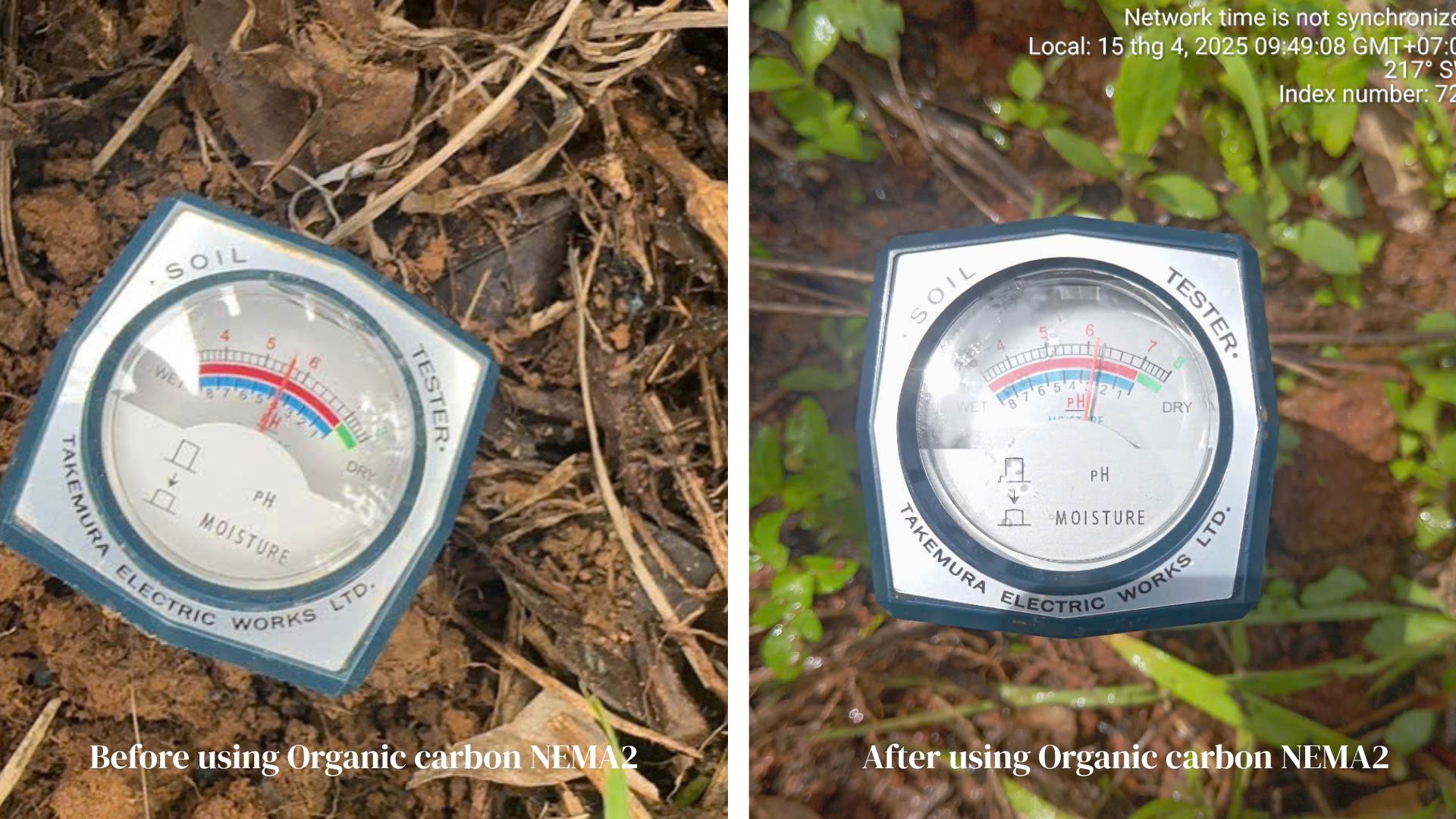
Figure: Soil pH increases after using Organic Carbon NEMA2 to restore degraded soil.
3. Enhancing Organic Matter (Humus) – Reviving Life in Degraded Soil
Humus is the soul of the soil, a well-decomposed, dark-brown organic substance. Degraded soil typically has very low humus content.
- Origin: Decomposed plant residues, manure, and root remains broken down by microorganisms.

Figure depicting Organic Carbon promoting the decomposition of rice stalks and roots to create humus, restoring degraded soil for the next crop.
- Benefits of humus for degraded soil:
Characteristic Benefit Improves soil structure Makes soil friable, increases aeration, drainage, and moisture retention. Retains nutrients Acts like a sponge, slowly releasing nutrients to plants. Promotes microorganisms Serves as a food source for beneficial microbes, aiding in nutrient mineralization. Provides nutrients Rich in N, P, K, and micronutrients in an available form.
Risks of using undecomposed organic matter for soil restoration:
- Can harm roots due to heat and toxic gases (NH₃, H₂S).
- Competes with crops for nutrients (nitrogen) during decomposition.
- May spread fungal pathogens if not properly composted.
Organic Carbon NEMA2 accelerates the decomposition of organic matter into humus, minimizing these risks and increasing the efficiency of degraded soil restoration.
IV. Conclusion: The Role of Organic Carbon in Restoring Degraded Soil
Restoring degraded soil is the cornerstone of sustainable agriculture. The application of Organic Carbon, especially NEMA2, plays a pivotal role in successful soil recovery strategies.
By enhancing nutrient retention, balancing pH, accelerating humus formation, and stimulating beneficial microbial ecosystems, Organic Carbon NEMA2 has proven to be a multifunctional solution that helps farmers restore degraded soil, increase crop yields, and move towards sustainability.
Investing in the restoration of degraded soil with Organic Carbon is a strategic move, ensuring long-term success and ecological balance for Vietnamese agriculture.
>> Learn more about the soil amendment product Organic Carbon NEMA2>> Read more on “THE EFFECTIVENESS OF SOIL AMENDMENT PRODUCTS IN IMPROVING SOIL PROPERTIES AND RICE GROWTH UNDER SALINE CONDITIONS”