The livestock structure of our country in the period of 2020 – 2023 accounts for the largest proportion of pig farming with a proportion of 60-65% (source: General Statistics Office), which has been maintained stably up to now. In which, the industrial scale with high density and concentrated farming accounts for more than 60%. The concentrated emissions of this model greatly affect the environment and are very difficult to handle. Developing such large-scale farming entails great pressure on environmental treatment, especially the odor spreading to residential areas and neighboring communities.
Main Odor and Emission Points in Pig Farming
Currently, with advantages in operation, biosafety as well as economic optimization, pig farming is mainly developed according to the industrial model, cold barns, concentrated with large scale and farm area. Therefore, the amount of waste and odor generated daily also increases, with the main sources:
Farm odors arise mainly from newly discharged manure:
- Mainly H2S and volatile organic acids) and new urine (NH3) of livestock on the barn floor, most of the odor is continuously pushed out by the exhaust fan, easily spreading to the surrounding environment over a very large range.

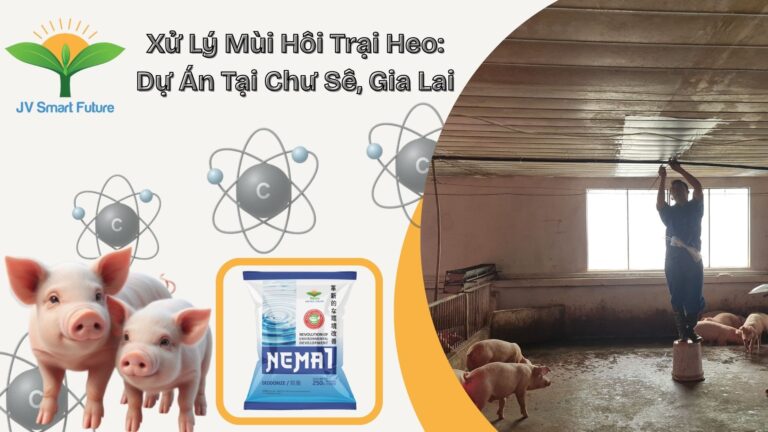
New animal waste inside the barn is the main source of odor (source: JVSF)
Odor from other areas on the farm such as:
- Wastewater ditches, sumps, wastewater treatment systems, biogas tanks. There is odor in these areas but the load will be less than inside the barn, because when there is water, anaerobic microbial activities often occur, mainly creating CH4 (odorless). The odor in this area is only generated from the surface of the wastewater, so it is insignificant or the load is not enough to affect distant areas.

The odor from other areas is only generated from the surface (source: JVSF)
Therefore, the odor treatment solution needs to focus on the new waste discharged daily on the floor of the barn.
Current Odor Treatment Solutions for Pig Farms
Organic Carbon Application Solution – Nema1
Organic Carbon is a new material originating from Japan, created by processing cellulose at the atomic level through a special manufacturing process. This is a material that does not exist in nature but is completely synthesized by modern technology. Organic Carbon has an extremely good ability to absorb ions, it is a highly active allotropic form of the element Carbon. Thanks to that, Organic Carbon material easily attracts other substances, and quickly decomposes and decomposes waste as well as toxic gases in the living environment.

Image of Organic Carbon attracting and decomposing toxic gases such as H2S, NH3 (source: JVSF) In addition, the special properties of Organic Carbon also support the immune system of livestock, increase resistance to diseases and significantly reduce rearing time (good weight gain).
According to reports, this solution handles most of the total livestock gases, and thoroughly handles the Main odor in livestock farming.

Chart of odor treatment efficiency of Organic Carbon (source: JVSF)
References: Introduction link to Pig farm treatment solutions: https://jvsf.vn/chuyen-trang-nuoi-heo-lon, Video link to pig farming environment treatment solutions: https://youtu.be/j-c0m1SRtq0
Using microorganisms
As a traditional solution, using microbial preparations is a popular solution today. However, the disadvantage of this method is that before use, it is necessary to culture and adjust the density of microorganisms corresponding to the waste load; select the type of microorganisms suitable for the waste; slow processing time; unsafe to use directly inside the barn… are limitations, so the actual application in Vietnam is still inadequate and has not been thoroughly handled.

Using microorganisms in treating farm odors (illustrative image)
Using a net cover behind the exhaust fan, spraying essential oils (mainly water mixed with essential oils)
Covering a net behind the exhaust fan is one of the methods that farms are interested in and researching to invest in. However, the source of the farm odor comes from the waste and new wastewater on the barn floor. Solving it from behind the exhaust fan is considered a “top-down” method, not thorough, deceiving the sense of smell in locations near the barn. When far from the barn, such as in concentrated residential areas, the smell of essential oils is gone and the odor is still not treated. This solution is also wasteful with high initial investment costs. In addition, the rear mesh reduces the velocity of fresh air inside the cage, affecting the breathing of livestock.

Cover the mesh behind the exhaust fan (illustrative image)
Other odor treatment methods
In developed countries such as Europe and North America, the gas neutralization method is quite commonly applied. To apply this method, it is necessary to design and invest in a gas recovery system from the beginning. The gas inside the barn is brought to a centralized treatment area, where the gas passes through the filter plates: Acid filter (treating NH3) – Base filter (treating H2S) – Microbiological filter (treating remaining volatile fatty acids).

Gas neutralization method (illustrative image)
In Asian countries (popular in China), the method of neutralizing gas (illustrative image) is widely used in aquaculture. Quoc, Thailand) the method of using highly oxidizing chemicals to decompose odor-causing molecules is commonly used.
However, the application of these methods in Vietnam is considered unfeasible because it only treats the tip of the problem, not thoroughly due to the limited coverage of the solution on the waste; the initial investment cost is very high, it is necessary to upgrade the existing system model of the farms in terms of exhaust fans, operation, in addition, the chemicals used are toxic to livestock and humans… as well as the subsequent wastewater treatment solutions when there are many difficult-to-treat chemical residues.