Các nội dung chính trong bài viết
ToggleHousehold and family livestock farming
Household livestock farming is not only a source of essential food but also an important source of income for many rural households. However, one of the biggest challenges of this model is the problem of odors from livestock waste, which seriously affects human health and the living environment. Odor treatment not only improves the quality of life but also contributes to the sustainable development of the livestock industry.
Causes of odors in livestock farming on farms and in households
Odors in livestock farming originate from many factors, including:
Feces and urine of livestock
-
Feces and urine contain volatile organic compounds, especially ammonia (NH₃) and hydrogen sulfide (H₂S).
-
These compounds have an unpleasant odor, directly affecting the air quality in and around the barn.
Organic matter decomposition process
-
When feces and wastewater accumulate, bacteria and microorganisms begin to decompose organic matter.
-
This process produces toxic gases such as methane (CH₄), ammonia (NH₃), and hydrogen sulfide (H₂S), which increase odors and pollute the environment.
Poor sanitation system
-
Public housing that is not cleaned regularly leads to waste accumulation, creating favorable conditions for odor-causing bacteria to grow.
-
Public housing floors, feeders, and drinkers that are not cleaned regularly also contribute to increased odors and the risk of spreading disease.
Ineffective ventilation and drainage systems
-
Public housing that lacks good ventilation will cause toxic gases to accumulate, increasing odors.
-
Poor drainage systems cause wastewater to stagnate, creating a favorable environment for odor-causing bacteria to grow.
Leftover food and bedding
-
Feed If excess litter is not cleaned up promptly, it will decompose, causing a bad smell.
-
Bedding (such as straw, sawdust) if not replaced regularly will also become moldy and create an unpleasant smell.
Measures to control odors in pig farming households
Treat odors in pig pens
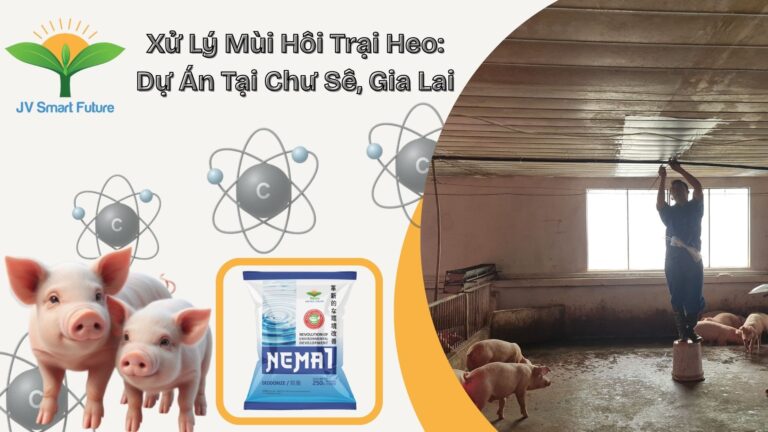
Use NEMA1 Organic Carbon
Products such as Nema1 Organic Carbon (Organic Carbon Japan) have been proven effective in treating odors. They have the ability to:
-
Quickly decompose toxic gases such as NH₃ and H₂S, improving air quality in barns.
-
Support beneficial microorganisms to grow, promote the decomposition of organic waste into high-quality fertilizer.
-
Repel flies, reduce the risk of spreading diseases.
Using Microorganisms
-
Beneficial microorganisms in microbial preparations help quickly decompose animal feces and urine, minimizing the generation of toxic gases such as ammonia (NH₃) and hydrogen sulfide (H₂S).
-
However, to be effective, it is necessary to understand the strain of microorganisms and the conditions for microorganisms to develop. development
-> See the comparison of Organic Carbon and Microorganisms at the end of the article
Clean the barn regularly
-
Collect and treat waste daily to avoid odor accumulation.
-
Clean the barn floor, feed troughs, and water troughs periodically to limit the growth of odor-causing bacteria.
-
Use biological bedding to absorb waste, naturally reducing odors.
Compost properly
Composting not only helps to treat odors but also creates a source of high-quality organic fertilizer. Effective composting process includes:
-
Mix odor treatment with water and spray evenly on the manure before composting.
-
Composting time is from 30 – 45 days to ensure that the manure is completely decomposed, without causing unpleasant odors.
Improve ventilation and drainage systems
-
Design barns with good ventilation to minimize the accumulation of toxic gases.
Regular wastewater treatment to prevent odor-causing bacteria from growing.
Comparison of Nema1 and microbial preparations in livestock odor treatment
The comparison table is a summary of factors between the two applications that JVSF livestock engineers have compiled, customers can refer to more.
|
Factors good |
Organic carbonNEMA 1 |
MICROBES |
|
Mechanism Processing |
Atomic carbon particles will penetrate with organic molecules, macromolecules of waste and decompose. |
A strain of microorganism only eats certain types of waste, so it is necessary to combine a number of different strains for treatment. |
|
Effective |
Immediate odor reduction. Effective odor treatment (90% NH3 and 80% total odor) |
Need to cultivate, ensure conditions for microorganism microorganisms grow in sufficient quantity. The normal odor treatment efficiency is 60%. |
|
Application ability |
Easy, no special conditions of space, environment or temperature are required. When adjusting the volume of waste or needing to increase the treatment efficiency, simply increase/decrease the dosage or spray frequency. When mixed, it can be used many times without affecting the efficiency. |
It is necessary to meet and maintain favorable conditions for microorganisms. Adjusting the volume of waste affects microorganisms a lot. To increase efficiency, it is necessary to handle difficult odors, and it may be necessary to change the strain of microorganisms. When mixing the biological solution, it is necessary to mix it in the correct ratio. If there is excess, it will be a waste because if mixed for a long time, the quality of the microorganisms will decrease. Cost of use: Cost savings compared to the effectiveness. Depending on the strain of microorganisms. But to achieve relatively high efficiency, the cost is also high. |
|
Conclusion |
Nema1 is very suitable for household livestock farming because it is easy to use, suitable for many types of environments and livestock scales, and has very good cost and efficiency. |
When using microorganisms, customers should carefully understand the technical requirements, types of microorganisms and have an effective usage plan, suitable for livestock conditions and scale. |