
A Comprehensive Analysis of NEMA Organic Carbon
Origin: From Invention to Commercialization

The development history of Organic Carbon is a story of close and transparent collaboration, connecting inventors, the scientific community, and businesses. The verified development timeline is as follows:
- Scientific Research and Development: To validate and further develop the technology, a pioneering research team, led by Dr. Yukihiro Sugiyama and his colleagues at the University of Tokyo, conducted research funded by Mr. Kunimichi Sato (who was also the representative for the initial invention registration). This work successfully refined cellulose, creating a new form of carbon with an amorphous structure at the atomic scale.
- Invention Registration: The technology’s foundation originates from a patent, establishing the inventor and initial ownership representative for the pioneering research team led by Dr. Yukihiro Sugiyama as Mr. Kunimichi Sato.
- Commercial Transfer: A commercial contract signed on May 26, 2020, formalized the complete transfer of the patent, technology, and production line. The participating parties included:
- Transferor: GATE KEEPER COMPANY LIMITED, a legal entity in Japan representing the research team for the transfer.
- Transferee: JAPAN VIETNAM SMART FUTURE JOINT STOCK COMPANY (JVSF).
- Implementation in Vietnam: After the transfer was completed, the Japanese research team came directly to Vietnam to manage production, and Dr. Yukihiro Sugiyama took on the role of Deputy General Director of Production, Research, and Development at JVSF.
This clear timeline, from the initial invention (Kunimichi Sato), through the scientific research phase (Dr. Yukihiro Sugiyama), to the official commercial transfer, has thoroughly resolved questions about the technology’s transparency and origin.
Distinctive Properties
This invention proposes a carbon material in an “atomic state” and its manufacturing method, possessing superior ion adsorption capabilities compared to fullerenes or nanotubes. This carbon material is very similar to its state of existence in organic compounds (hence the name Organic Carbon), with a size close to the atomic state (diameter less than 1 nm, theoretically 1.66 Å). It is produced by pyrolyzing organic raw materials in a strictly controlled environment that prevents crystallization, thereby retaining extremely high surface chemical activity.

Organic Carbon material possesses an extremely good ability to capture ions. When diffused in water, there are about 34 million Organic Carbon particles dissolved in 1 ml of water (as measured by an agency under the Ministry of Science and Technology of Japan). With an atomic size of only about 0.16 nm, the ion adsorption capacity of this material is 4 times higher than that of fullerene C60, allowing it to easily participate in organic bonding chains, synthesize, and form an energy source for living organisms.

Comparison of Properties
| Organic Carbon | Other Carbon Compounds |
|---|---|
|
|
Commercialization in Vietnam and Prestigious Certifications
In Vietnam, JAPAN VIETNAM SMART FUTURE JOINT STOCK COMPANY (JVSF) is the sole manufacturer and distributor of products from Organic Carbon technology under the NEMA brand. The company operates a 5-hectare factory in Long An, equipped with modern production lines from Japan and has achieved ISO 9001:2015 quality management certification.
The main product lines that have been commercialized include:
- NEMA1 – Environmental Treatment Product: Specializes in deodorizing livestock farms, treating wastewater, and industrial sanitation.
- NEMA2 – Soil Amendment Product: Used in agriculture as a high-grade Biostimulant to improve soil structure, promote organic composting, and increase crop yields.
To affirm quality and safety, JVSF’s products have obtained several prestigious certifications, notably:
- Japanese Organic Certification (JAS OMJ): Allows NEMA2 products to be used in organic farming according to Japan’s strict standards.
- ISO 22000:2018: A standard for food safety management systems, ensuring the product is safe for use in the agricultural and food processing chain.
- Vietnam Golden Brand of Agriculture 2021.
- VietStock Awards 2024.
Diverse Applications

ORGANIC FERTILIZER PRODUCTION
Promotes the decomposition of organic matter, accelerates the composting rate, enriches nutrients, and increases the humus content in fertilizer. Organic Carbon also helps to deodorize, inhibit pathogenic bacteria, and reduce flies and mosquitoes during the composting process.

SOIL IMPROVEMENT
Supplementing organic carbon helps improve soil structure, making it looser, increasing water retention, and preventing erosion. The product helps break down hard-to-dissolve nutrients, balance pH, detoxify the soil from chemical residues, and create an ideal environment for beneficial microorganisms to thrive.
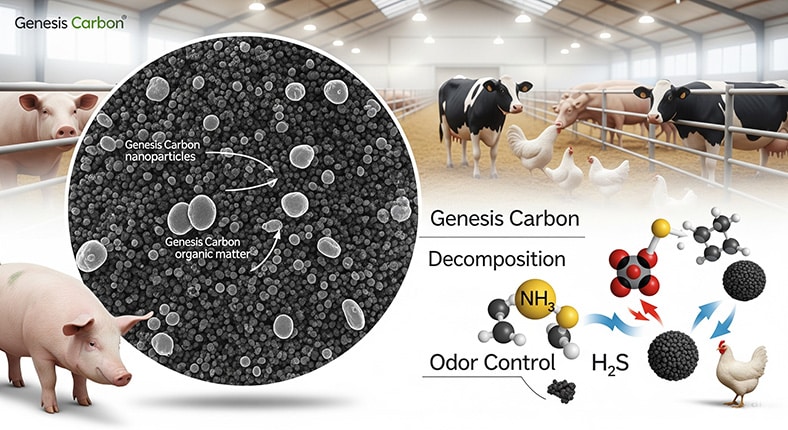
LIVESTOCK ODOR TREATMENT
Effectively absorbs and decomposes odor-causing toxic gases such as Ammonia (NH₃) and Hydrogen Sulfide (H₂S), minimizing air pollution. This significantly improves the living environment, reduces stress, prevents diseases, and enhances the overall health of the livestock.

SANITATION IN PROCESSING & SLAUGHTERING
Organic Carbon thoroughly treats odors arising from the processing and slaughtering of livestock, poultry, and seafood. The product is biodegradable, non-toxic, and safe for direct contact with food and the production environment.

WASTEWATER TREATMENT
Provides an easily absorbable carbon source, activating and increasing the density of beneficial microorganisms, which helps decompose organic pollutants and significantly reduce BOD/COD levels. The product also helps stabilize pH and improves the overall efficiency of the treatment system.

EMISSION & ODOR TREATMENT
Neutralizes and decomposes acidic exhaust gases like H₂S, NH₃, and SO₂, helping to reduce corrosion of pipes and equipment. It is an effective, environmentally friendly odor control solution that helps optimize the operating and maintenance costs of the emission treatment system.

WASTE & ENVIRONMENTAL TREATMENT
Applied at landfills, collection areas, and waste treatment plants to control odors, accelerate decomposition, and reduce toxic gas concentrations. This solution helps improve air quality, protect public health, and minimize negative impacts on the surrounding environment.

EMISSION REDUCTION & CLIMATE CHANGE RESPONSE
Reduces greenhouse gas emissions (CH₄, N₂O, CO₂) in agriculture and industry. By enhancing the soil’s ability to absorb and store carbon, the product directly contributes to mitigating climate change in line with global commitments.

ECOSYSTEM IMPROVEMENT
Restores and stabilizes microbial systems in soil and water, protecting biodiversity. The solution helps reduce pollution and enhances nature’s self-cleaning capacity, thereby building a healthy ecosystem and moving towards a circular economy and sustainable development.
